

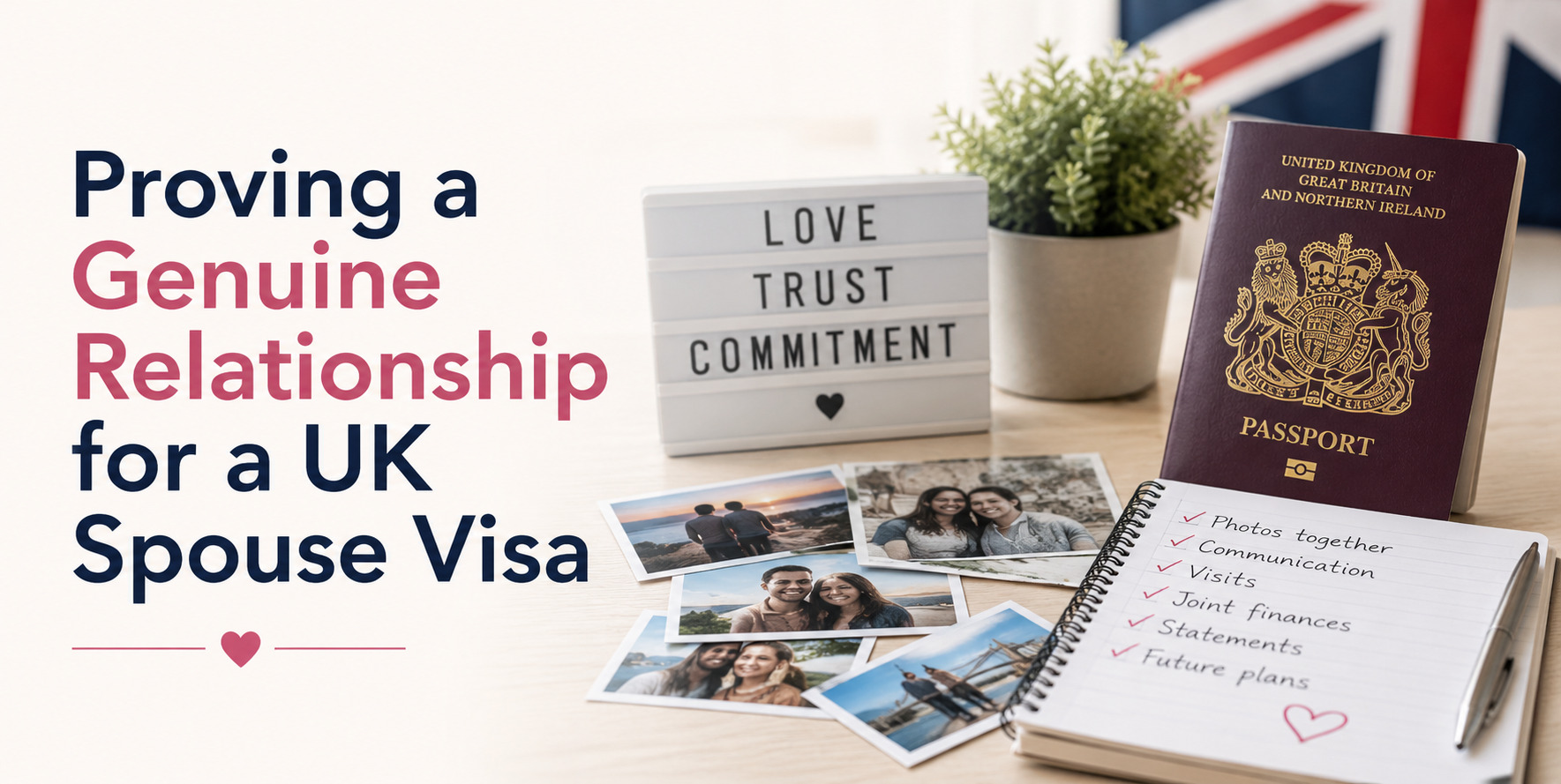
A marriage certificate confirms that a legal marriage exists, but it is only one part of a successful UK Spouse Visa application. Under Appendix FM, applicants must also show that their relationship is genuine and continuing. Rather than relying on a single document, the Home Office considers the overall evidence and the circumstances of each couple when assessing an application.
For many couples, knowing what evidence to provide can be challenging, particularly if they have lived apart because of work, study or other personal circumstances. A well-prepared application should present a clear picture of your relationship through consistent and relevant supporting documents.
Whether you are applying for a Family Visa UK, preparing for a Spouse Visa Extension, or planning your first Partner Visa UK application, understanding how the genuine relationship requirement works can help you avoid common mistakes. This guide explains the evidence typically considered and how to present it effectively under the Immigration Rules.
When preparing a UK Spouse Visa application, many couples focus on collecting documents without first understanding what they are expected to prove. The Home Office is not simply looking for evidence that you are married or in a civil partnership. Instead, the application must show that your relationship is genuine and ongoing and that you intend to live together permanently in the UK, as required under Appendix FM. Applications are assessed on their individual facts, with caseworkers considering all the evidence provided rather than relying on a single document.
A genuine relationship exists in reality and is not entered into solely for immigration purposes. A subsisting relationship means the partnership continues to exist at the time the application is decided.
Home Office caseworkers typically look for evidence that demonstrates a shared life over time. This does not mean every couple must provide identical documents. Someone who has recently married may have different evidence from a couple who have lived together for several years. The key is that the documents should tell a consistent and credible story.
Evidence may help show:
The stronger and more consistent the evidence, the easier it becomes for a caseworker to understand the history of your relationship.
Related reading: If you are applying for a UK spouse visa, our guide to the Family Visa UK explains how eligibility differs across family-based applications.
The genuine relationship requirement applies to most applicants applying as a partner under Appendix FM, including:
| Applicant type | Relationship requirement |
| Husband or wife | Must show the marriage is genuine and continuing |
| Civil partner | Must demonstrate a genuine and subsisting partnership |
| Unmarried partner | Usually needs to show they meet the relevant relationship requirements under the Immigration Rules |
| Fiancé, fiancée or proposed civil partner | Must show the relationship is genuine and there is a genuine intention to marry or enter a civil partnership within the required period after arrival |
Although the evidence required will vary depending on the route, the underlying principle remains the same: applicants must satisfy the Home Office that the relationship is genuine.
If your circumstances are unusual, such as extended periods living apart or complex immigration histories, providing a clear explanation alongside supporting evidence can help present your application more effectively.
Not every family immigration route applies the same relationship rules. While a Partner Visa UK falls under Appendix FM, other routes have different eligibility requirements.
For example:
Understanding which Immigration Rules apply to your application is important because the required evidence can differ from one route to another.
If you are unsure whether your application should be made as a UK Marriage Visa, a UK Relationship Visa, or another family route, obtaining advice before applying can help ensure you submit evidence that matches the correct legal requirements.
Many applicants worry about whether they have collected the "right" documents for a UK Spouse Visa. In practice, the Home Office does not assess an application by counting documents. Instead, caseworkers consider whether the evidence, viewed as a whole, shows that your relationship is genuine and continuing. This means a smaller collection of clear, consistent evidence is often more helpful than submitting a large volume of repetitive paperwork. The burden is on the applicant to demonstrate that they meet the relationship requirements on the balance of probabilities.
If you are applying for a Family Visa UK, your supporting documents should complement the information in your application form rather than contradict it. Dates, addresses, and key milestones should align across all evidence to create a clear timeline of your relationship.
There is no universal checklist that proves every Partner Visa UK application. Instead, decision-makers consider a range of evidence alongside your individual circumstances.
They may look at:
A single document rarely proves a relationship on its own. Instead, different pieces of evidence should work together to present a consistent picture.
A genuine relationship can still face additional scrutiny if the evidence is incomplete or inconsistent.
Some common issues include:
| Issue | Why it may raise questions |
| Different relationship dates | Creates inconsistencies in the application |
| Missing explanation for periods apart | Leaves important gaps in the relationship history |
| Limited supporting evidence | Makes it harder to understand how the relationship has developed |
| Conflicting addresses or personal details | Can affect the overall credibility of the application |
| Documents that do not match other evidence | May require further clarification |
Where there are unusual circumstances, such as work commitments overseas or periods of separation due to study under Appendix Student or employment under Appendix Skilled Worker, providing a brief explanation with supporting documents can help caseworkers understand the context.
Yes. A request for additional information does not necessarily mean that your UK Marriage Visa application is likely to be refused. It may simply mean the Home Office needs further documents or clarification before reaching a decision.
Responding promptly and providing relevant evidence is usually more helpful than submitting unnecessary paperwork. If you are uncertain about the documents required for your circumstances, particularly where your case involves complex family arrangements or previous immigration applications, seeking advice from an IAA (Immigration Advice Authority)-regulated adviser before responding can help ensure your application remains clear and well supported.
One of the most common questions applicants ask is, "What documents should I submit?" The answer depends on your individual circumstances. The Home Office does not publish a fixed checklist that applies to every UK Spouse Visa application. Instead, decision-makers consider whether the evidence, taken together, demonstrates a genuine and continuing relationship under Appendix FM. The aim is not to provide the greatest number of documents but to submit evidence that is relevant, consistent, and easy to understand.
If you are applying for a Family Visa UK, organising your documents into clear categories can make your application easier to review. Where a document does not tell the full story, a brief explanation may help provide useful context.
These documents establish the legal basis of your relationship and confirm your identities.
Typical examples include the following:
These documents are usually the starting point of an application but should be supported by additional evidence showing that the relationship continues beyond the legal ceremony.
If you have been living together, documents showing a shared address can help demonstrate your day-to-day life as a couple.
Examples include:
| Document | What it helps demonstrate |
| Joint tenancy agreement or mortgage | Shared residence |
| Council Tax bills | Same residential address |
| Utility bills | Ongoing cohabitation |
| NHS or GP correspondence | Official records show the same address |
| Bank or government letters | Consistent residential history |
Where you have not lived together continuously, explain the reason and provide evidence supporting your circumstances.
Shared finances can demonstrate that you manage aspects of your lives together, although not every couple will have joint accounts.
Relevant documents may include:
The evidence should reflect your actual circumstances rather than being created solely for the application.
Here is a full guide on UK Spouse Visa MIR Documents.
Couples who have spent time apart because of employment, study or family commitments may rely more heavily on communication records and travel history.
Useful examples include:
It is generally more effective to provide a representative selection over time than hundreds of similar screenshots.
For applicants who have lived apart due to studies under Appendix Student or employment under Appendix Skilled Worker, a short explanation alongside supporting evidence can help explain the timeline of the relationship. Guidance confirms that applications are assessed on the evidence as a whole rather than any single document.
Living apart does not automatically mean you cannot qualify for a UK Marriage Visa or UK Spouse Visa. Many genuine couples spend time in different countries because of employment, education, immigration restrictions or family responsibilities. The Home Office recognises that not every relationship follows the same pattern. Where partners have not lived together continuously, the focus shifts to whether there is credible evidence of an ongoing commitment and a genuine intention to live together permanently in the UK.
The key is to explain why you lived apart and support your explanation with relevant documents rather than leaving gaps for the caseworker to interpret.
Temporary separation can arise for many legitimate reasons, including:
A clear timeline helps demonstrate that the relationship continued despite the distance.
Where you have lived apart, consider providing a balanced selection of evidence such as:
| Evidence | What it demonstrates |
| Travel bookings and passport stamps | Visits to see one another |
| Call logs and message history | Regular communication |
| Photographs from different visits | An ongoing relationship over time |
| Money transfers or shared expenses | Continued financial support, where applicable |
| Letters explaining periods apart | Context behind your circumstances |
Avoid submitting hundreds of screenshots. A representative sample covering different stages of the relationship is usually easier for a caseworker to review than repetitive evidence.
If there are lengthy gaps in communication or visits, include a brief explanation supported by evidence where possible. This helps present a complete picture rather than leaving unanswered questions.
A genuine relationship can still face delays or even refusal if the supporting evidence is unclear or inconsistent. In many Partner Visa UK and UK Spouse Visa applications, the issue is not that the relationship is questioned, but that the documents do not clearly demonstrate how the couple meet the requirements under Appendix FM. A carefully prepared application should be accurate, well organised and supported by evidence that aligns with the information provided in the application form. The Home Office assesses all the evidence together rather than relying on one document alone.
The following issues commonly arise in family visa applications:
| Common mistake | Why it matters |
| Providing inconsistent dates | Differences in relationship timelines, addresses or travel history may raise questions. |
| Relying only on a marriage certificate | A marriage certificate confirms the legal relationship but does not, by itself, demonstrate that the relationship is genuine and continuing. |
| Submitting excessive duplicate evidence | Hundreds of similar screenshots or repeated documents can make the application harder to review. A representative sample is usually more effective. |
| Leaving gaps unexplained | Long periods apart due to work, study or family commitments should be explained with supporting evidence where possible. |
| Using documents that are not translated | Documents not in English or Welsh generally need to be accompanied by an appropriate translation. |
Before submitting your Family Visa UK application, it is worth checking that
Taking time to organise your documents can make it easier for a caseworker to understand your relationship and assess your application fairly.
Bonus read: UK Family Reunion Visa
The documents you gather for your first UK Spouse Visa application can also be valuable later in your immigration journey. If you continue living together and keep clear records of your relationship, preparing a future Spouse Visa Extension or settlement application is often more straightforward. Although every application is assessed on its own merits, maintaining consistent evidence over time helps demonstrate that your relationship continues to meet the requirements under Appendix FM.
Rather than trying to collect years of paperwork at the last minute, it is sensible to keep important documents organised as your circumstances change.
The following documents may be useful for future applications:
| Evidence | Why it is helpful |
| Joint tenancy or mortgage documents | Shows ongoing cohabitation |
| Council Tax and utility bills | Confirms a shared address over time |
| Joint bank statements | Demonstrates shared financial responsibilities |
| Official correspondence | Helps establish a continuous residential history |
| Birth certificates of children, where applicable | Supports family circumstances |
Keeping copies of these documents as they are issued can make future applications easier to prepare.
When applying for a Spouse Visa Extension, you will normally need to demonstrate that your relationship continues to be genuine and that you still meet the relevant Immigration Rules. The Home Office may consider updated evidence showing that you and your partner have continued your life together since your original application.
If your circumstances have changed, such as moving home, changing employment or welcoming a child, ensure your supporting documents reflect those changes accurately.

A practical guide to choosing the right university to study in UK, covering courses, cost, admission and how it affects your student visa journey.
A calm, practical guide to the Life in the UK Test and the wider citizenship requirements for visa holders preparing to apply for naturalisation.
Dual Citizenship UK explained, fees, processing times, Naturalisation UK requirements, Citizenship by Descent, and the Life in the UK Test.
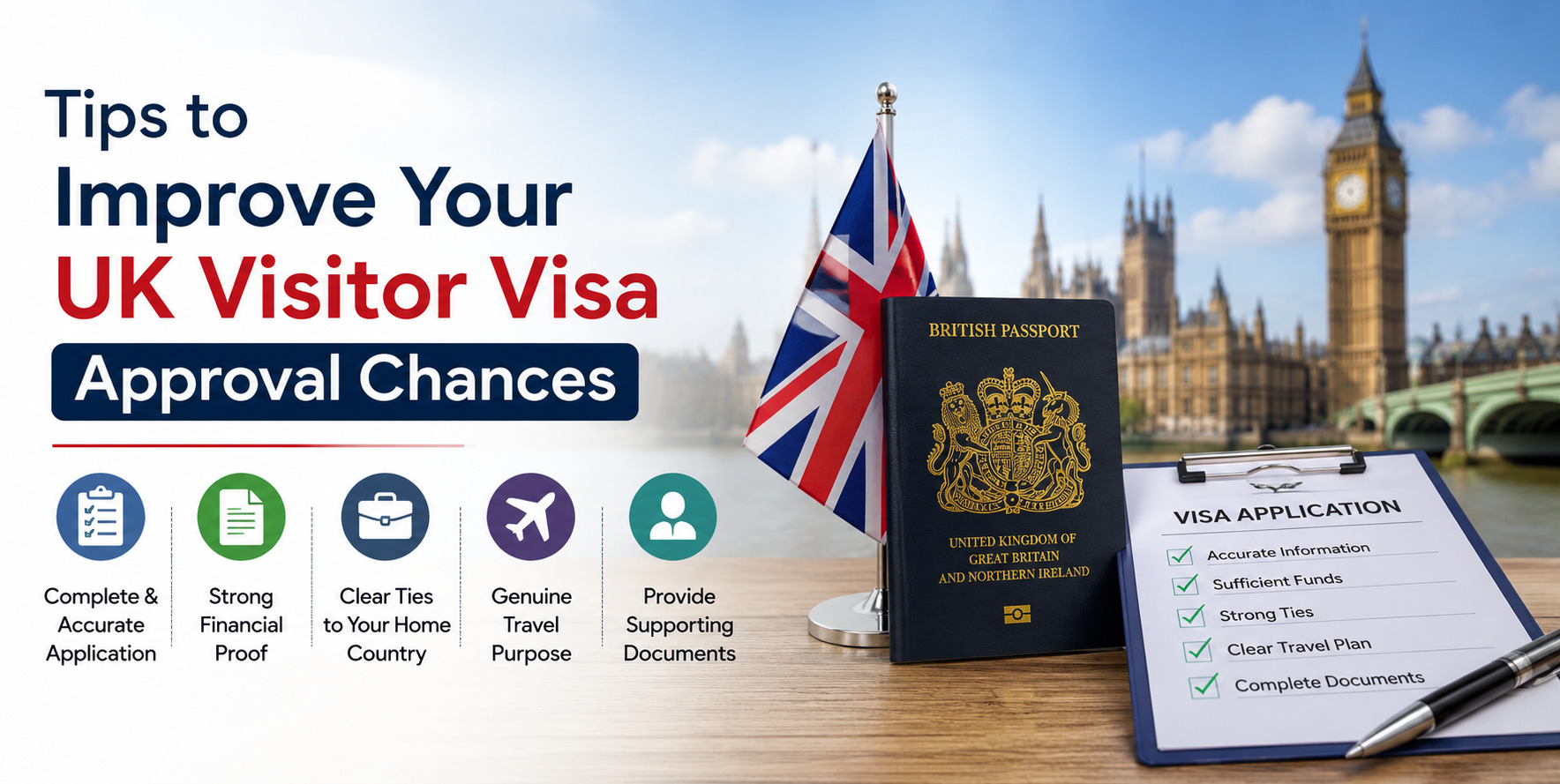
Struggling with your UK Visitor Visa application? Discover practical, adviser-led tips on documents, finances, home ties, and cover letters to boost approval.

Skilled Worker Visa UK eligibility depends on your occupation and role. Discover which jobs qualify and what employers need to check.

Learn the employer requirements for a Skilled Worker Visa UK, including sponsor licences, compliance duties, and hiring eligibility criteria. Explore more.
Applying for British Citizenship by naturalisation? Learn the eligibility rules, required documents, costs, and application steps. Explore more.
Discover how Indefinite Leave to Remain can offer long-term stability, work flexibility, and a path to British citizenship. Learn more today.
Understand the most common UK student visa refusal reasons in 2026 and learn when to appeal or reapply. Explore your next steps with confidence.
Use our Immigration Skills Charge calculator to estimate sponsorship costs per worker. Discover what UK employers actually pay and plan ahead.
No. A marriage certificate confirms that a legal marriage has taken place, but it does not, by itself, prove that the relationship is genuine and continuing. The Home Office normally expects applicants to provide additional evidence showing their shared life, such as proof of living together, regular communication or shared financial responsibilities.
There is no prescribed number of messages or call records. Instead of submitting hundreds of screenshots, choose a representative sample that shows regular contact throughout your relationship, particularly if you have spent time living apart. Quality and consistency are generally more helpful than quantity.
Not necessarily. Many couples successfully apply without one. If you do not have a joint account, other evidence, such as tenancy agreements, utility bills, travel records or official correspondence, may help demonstrate your relationship, depending on your circumstances.
Yes, provided you can demonstrate that the relationship is genuine and ongoing. If work, study under Appendix Student, or employment under Appendix Skilled Worker has kept you apart, explain the reasons clearly and support them with relevant evidence.
In some circumstances, family members may be able to join a person who has refugee status or humanitarian protection through the appropriate immigration route. However, these applications may fall under Appendix Family Reunion rather than Appendix FM, so the eligibility requirements can differ.

GMS Immigration is a trusted UK-based visa consultancy offering expert guidance for visitor, work, family, and settlement visas.With over 10 years of experience and a high success rate, they provide personalised, transparent support to help clients achieve their UK immigration goals.